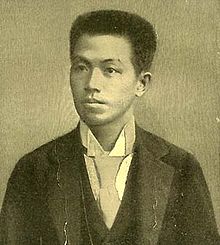
 Emilio Aguinaldo y Famy (March 22, 1869 – February 6, 1964) was a Filipino general, politician, and independence leader. He played an instrumental role during the Philippines' revolution against Spain, and the subsequent Philippine-American War or War of Philippine Independence that resisted American occupation.
Aguinaldo became the Philippines' first President. He was also the youngest (at age 29) to have become the country's president, the longest-lived president (having survived to age 94) and the president to have outlived the most number of successors.
Family and Education
Emilio Aguinaldo y Famy (March 22, 1869 – February 6, 1964) was a Filipino general, politician, and independence leader. He played an instrumental role during the Philippines' revolution against Spain, and the subsequent Philippine-American War or War of Philippine Independence that resisted American occupation.
Aguinaldo became the Philippines' first President. He was also the youngest (at age 29) to have become the country's president, the longest-lived president (having survived to age 94) and the president to have outlived the most number of successors.
Family and Education
He was the seventh of eight children. His parents were of Chinese and Tagalog descent. His father, Carlos, died when Aguinaldo was just nine years old. After graduating from the University of Santo Thomas and at the San Juan de Letran College in Manila, Aguinaldo returned home to Kawit, where he developed a growing awareness of Filipino frustration with Spanish colonial rule.
At the age of 17, Emilio was elected cabeza de barangay of Binakayan, the most progressive barrio of Cavite El Viejo. He held this position, representing the local residents, for eight years. He also engaged in inter-island shipping, traveling as far south as the Sulu Archipelago. Once on a trading voyage to the nearby southern islands, while riding in a big paraw (sailboat with outriggers), he grappled with, subdued, and landed a large man-eating shark, thinking it was just a large fish.
In 1893, the Maura Law was passed to reorganize town governments with the aim of making them more effective and autonomous, changing the designation of town head from gobernadorcillo to capitan municipal, effective 1895. On January 1, 1895, Aguinaldo was elected town head, becoming the first person to hold the title of capitan municipal of Cavite El Viejo.v
Marriage
On January 1, 1896 he was married to Hilaria Aguinaldo (1877-1921) the couple had five children namely Carmen, Emilio, Maria ,Cristina, and Miguel. Hilaria died of leprosy on March 6, 1921, he was married to Maria Agoncilio on July 14, 1930 until her death in 1963.
Philippine Revolution
In 1894, Aguinaldo joined the Katipunan or the K.K.K., a secret organization led by Andrés Bonifacio, dedicated to the expulsion of the Spanish and independence of the Philippines through armed force. Aguinaldo used the nom de guerre Magdalo, in honor of Mary Magdalene.8200 His local chapter of the Katipunan, headed by his cousin Baldomero Aguinaldo, was also called Magdalo.
The Katipunan revolt against the Spanish began in the last week of August 1896, in San Juan del Monte (now part of Metro Manila). However, Aguinaldo and other Cavite rebels initially refused to join in the offensive due to lack of arms. Their absence contributed to Bonifacio's defeat. While Bonifacio and other rebels were forced to resort to guerrilla warfare, Aguinaldo and the Cavite rebels won major victories in set-piece battles, temporarily driving the Spanish out of their area.
On February 17, 1897, Aguinaldo and group of katipuneros defeated Spanish forces led by General Camilo de Polavieja at the Battle of Zapote Bridge in Cavite. General Edilberto Evangelista, civil engineer, revolutionary and trench builder, was killed in the battle. The province of Cavite gradually emerged as the Revolution's hotbed and the Aguinaldo-led katipuneros had a string of victories there.
However, conflict between the Magdalo and another Cavite Katipunan faction, the Magdiwang, led to Bonifacio's intervention in the province. The Cavite rebels then made overtures about establishing a revolutionary government in place of the Katipunan. Though Bonifacio already considered the Katipunan to be a government, he acquiesced and presided over elections held during the Tejeros Convention in Tejeros, Cavite on March 22, 1897. Bonifacio lost the leadership to Aguinaldo, and was elected instead to the office of Secretary of the Interior. Even this was questioned by Daniel Tirona, claiming Bonifacio had not the necessary schooling for the job. Insulted, Bonifacio (drew out his gun and would have killed Tirona on the spot had he not been stopped) declared the Convention null and void, and sought to return to his power base in Morong (present-day Rizal).
Bonifacio refused to recognize the revolutionary government headed by Aguinaldo and attempted to reassert his authority, accusing the Aguinaldo faction of treason and by issuing orders contravening orders issued by the Aguinaldo faction. At Aguinaldo's orders, Bonifacio and his brothers were arrested and, in a mock trial lasting one day, convicted of treason, and sentenced to death. After some vacillation, Aguinaldo commuted the death sentence, but canceled his commutation order after being convinced by Generial Manuel Noriel, President of the Council of War the death sentence, and others prominent in his government that the sentence must stand. Andrés and Procopio were executed by firing squad on May 10, 1897 at Mount Hulog, about four kilometers west of Maragondon, Cavite.
Biak-na-Bato
Spanish pressure intensified, eventually forcing Aguinaldo's forces to retreat to the mountains. Emilio Aguinaldo signed the Pact of Biak-na-Bato. Under the pact, Aguinaldo effectively agreed to end hostilities and dissolve his government in exchange for amnesty and "$800,000 (Mexican)" (Aguinaldo's description of the amount) as an indemnity. The documents were signed on December 14 and 15, 1887. On December 23, Aguinaldo and other Katipunan officials departed for Hong Kong to enter voluntary exile. $400,000, representing the first installment of the indemnity, was deposited into Hong Kong banks. While in exile, Aguinaldo reorganized his revolutionary government into the "Supreme Council of the Nation".
One revolutionary general who remained in the Philippines, Francisco Makabulos, established a Central Executive Committee to serve as a provisional revolutionary government "until a general government of the Republic in these islands shall again be established." Meanwhile, Spanish officials continued to arrest and imprison Filipinos suspected of having been involved in the rebellion. The consequence of this disregard of the pact by both sides was the resurgence of the revolution.
In April 1898, war broke out between Spain and the United States. In the Battle of Manila Bay on May 1, 1898, the American Asiatic Squadron under Commodore George Dewey engaged and destroyed the Spanish Pacific Squadron, and blockaded Manila. Dewey provided transport to return Aguinaldo to the Philippines. Aguinaldo promptly resumed command of revolutionary forces and besieged Manila.
Independence and Government
After the outbreak of Spanish American War. Aguinaldo returned to the Philippines from Hong Kong to support the American forces in fighting against the Spaniards, arriving on May 19, 1898. After five days, Aguinaldo issued a proclamation in which he assumed command of all Philippine forces and established a dictatorial government with himself as dictator.
On 12 June, at Aguinaldo's ancestral home in Cavite, Philippine independence was proclaimed and The Act of Declaration of Philippine Independence was read. The act had been prepared and written in Spanish by Ambrosio Rianzares Bautista, who also read its proclamation.
On 18 June, Aguinaldo issued a decree formally establishing his dictatorial government. On June 23, another decree signed by Aguinaldo was issued, replacing the Dictatorial Government with a Revolutionary Government, with himself as President.
U.S. Territorial period
During the American occupation, Aguinaldo supported groups that advocated immediate independence, and helped veterans of the struggle. He organized the Asociación de los Veteranos de la Revolución (Association of Veterans of the Revolution), which worked to secure pensions for its members and made arrangements for them to buy land on installment from the government.
The display of the Philippine flag was declared illegal by the Sedition Act of 1907. This law was repealed on October 30, 1919.[41] Following this, Aguinaldo transformed his home in Kawit into a monument to the flag, the revolution and the declaration of Independence. As of 2011, his home still stands and is known as the Aguinaldo Shrine.
Aguinaldo retired from public life for many years. In 1935, when the Commonwealth of the Philippines was established in preparation for Philippine independence, he ran for president in the Philippine presidential election, 1935, but lost by a landslide to fiery Spanish mestizo Manuel L. Quezon. The two men formally reconciled in 1941, when President Quezon moved Flag Day to June 12, to commemorate the proclamation of Philippine independence. During the Japanese occupation, he cooperated with the Japanese, making speeches, issuing articles and infamous radio addresses in support of the Japanese—including a radio appeal to Gen. Douglas MacArthur on Corregidor to surrender in order to "spare the innocence of the Filipino youth."
After the Americans retook the Philippines, Aguinaldo was arrested along with several others accused of collaboration with the Japanese, and briefly jailed. He was released by presidential amnesty.
Aguinaldo was 77 when the United States Government fully recognized Philippine independence in the Treaty of Manila, in accordance with the Tydings-McDuffie Act of 1934.
Death
Aguinaldo died of coronary thrombosis at age 94 on February 6, 1964, at the Veterans Memorial Hospital in Quezon City. A year before his death, he had donated his lot and his mansion to the government. This property now serves as a shrine to "perpetuate the spirit of the Revolution of 1896."
In 1985, Bangko Sentral ng Pilipinas made a new 5-peso bill depicting a portrait of Aguinaldo on the front of the bill. The back of the bill features the declaration of the Philippine independence on June 12, 1898.
back